
Needham City Directory Shelves
Needham is a town, but city directory is the useful historical-search term for these printed resident and business volumes. The strongest starting points are the Needham Free Public Library, the State Library holdings, and the Library of Congress digitization. They do not form one uninterrupted series. Ask staff to confirm a particular volume before making a trip, and record the edition year rather than assuming a person appears every year.
| Collection | Years | Where Held | Access |
|---|---|---|---|
| Selected Needham directories | 1883–1938, with gaps | State Library’s Needham holdings; Needham local collection | Confirm the volume with staff |
| History and directory of Needham | 1888–1889 | Library of Congress | Free page images and OCR |
| Needham annual town reports | 1891–2024 | Needham Library history resources | Digital, searchable by report and page |
| Needham voting-list holdings | Selected years, 1924–2008 | State Library’s Needham holdings | Access and fields depend on the copy |
The record of holdings is safer than a claim of a continuous Needham publisher run. No official last printed year or complete Needham reverse-directory series was located. Needham historical voting lists and annual reports can supply a date-bound companion source, but neither should be turned into a current address claim.
Needham Directory Room Rules
The Needham Genealogy and Local History Room keeps physical and digital local material at 1139 Highland Avenue. Its collection gives Needham priority, then Massachusetts and New England. The holdings do not circulate, so a careful visit matters when a name, street, or institutional reference is too old for a web index.
Check in at the reference desk, sign the use record, and obtain a key before handling the material. The library’s collection policy limits bags in the room and describes careful copying and scanning practices. That process protects fragile Needham sources and keeps the image, page number, and edition tied together.
Note: Contact the library before a visit when a particular Needham volume or local-history resource is essential to the research.
Needham Directory 1888–89
The Library of Congress copy of the 1888–89 Needham directory is the best fully open example of how a historical Needham listing works. It contains a resident directory, street directory, business directory, schools, societies, churches, and town-officer material. Its OCR is useful for discovery, but the page image controls when a letter, abbreviation, or street name is unclear.
The Needham Genealogy and Local History Room is the official source for the local-history collection view shown here.
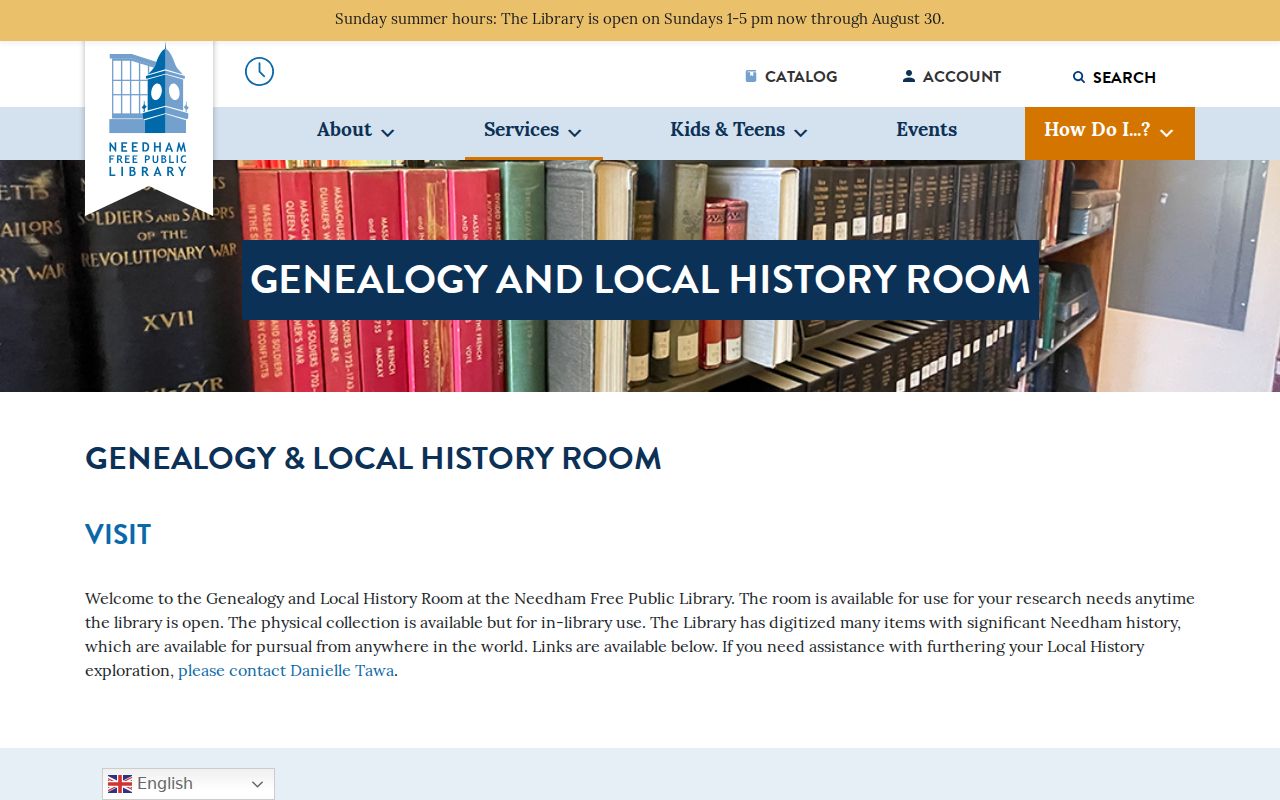
The Needham library collection shown above is a practical route to the printed context that OCR cannot supply. Pair a searchable hit with the scanned page, then save the page number and the exact form of the name before comparing another Needham directory volume.
Note: A search hit is a lead only until the original page image confirms the name, abbreviation, and street wording.
Reading Needham City Directory Entries
A Needham directory line is a compact historical statement, not a complete profile. The 1888–89 volume can pair a person’s name with an occupation or firm and a home street. It may also use a spouse or “Mrs.” notation, a corner reference, or a village code. The sample Needham entries for Moseley John and Morton Chas W show why the occupation, business relation, and street should be copied as printed rather than expanded into present-day conclusions.
| Name | Printed surname, initials, given name, spouse or relative notation when present. |
|---|---|
| Occupation or firm | A period description of work or business affiliation, not a modern status. |
| Address | Street, house number, corner, or village label exactly as printed. |
h or b | h marks home or house; b marks boarding or boards in this volume. |
| Ownership | Do not infer owner or renter status. The cited Needham volume does not generally state it. |
Note: A boarder, a historical occupation, or a single printed address should remain a dated clue, not a claim about a household today.
Needham Directory Entry Terms
The volume’s abbreviations are part of the evidence. Photograph or transcribe the Needham volume’s key before interpreting a short form, especially when the same surname appears more than once. A Needham street-order index can help with a location question, but research found no official complete Needham criss-cross series. Preserve that gap instead of making an address list seem complete.
- Criss-cross directory
- A directory arranged by street and number rather than by personal name. It is an address tool, not a proof of every resident.
- Householder index
- An index intended to lead a reader to a named household or address in a particular edition.
- Abbreviation key
- The volume’s own explanation of short forms such as
h,b, andcor. The printed key outranks a guess.
Needham Directory Images First
The Library of Congress OCR text makes a Needham surname, occupation, or street discoverable quickly. OCR can confuse initials, abbreviations, and faint type. Open the image, compare the line to the search text, and retain the original spelling even when a modern Needham map uses a different form.
That image-first practice is especially helpful for common surnames. In Needham, add the year, village code, firm, spouse notation, or street to distinguish similar entries. These small details are stronger than joining records on surname alone.
Needham Directory Timeline
Needham’s historical shelf is uneven, but its surviving milestones show how a local Needham directory trail can be built. The State Library genealogy guide is the appropriate route for confirming Needham holdings beyond the open Library of Congress volume.
- 1883: the earliest Needham directory year identified in the State Library holdings list.
- 1888–1889: A.E. Foss & Co.’s directory survives online through the Library of Congress.
- 1891–2024: Needham annual reports are available through the library’s linked digital resources.
- 1924–2008: selected Needham voting-list holdings add dated civic context.
- 1938: the latest directory year identified in the cited selected holdings, not a verified final publication year.
Note: The gaps between listed years are part of the historical record and should not be treated as evidence of a move.
Needham Directory Village Clues
Needham Center, Needham Heights, Great Plain Village, and Upper Falls have distinct historical associations. Rail development after 1853 shifted activity toward Needham’s Great Plain, and Needham Heights was formally distinguished from Newton in 1907. A Needham village reference helps date and place an entry, but it is not a present precinct, parcel boundary, or private neighborhood roster.
The Town of Needham history gives the local setting for mills, rail, and village growth. Use it to understand why an old entry may read differently from a modern address, then verify any location bridge with a map, deed, or assessor record.
Needham Directory Companion Sources
Directories are strongest when they are not asked to do every job. A household name can surface in one of the selected Needham directory volumes, while a yearbook can add a school-year setting and an annual report can place a civic institution in time. Needham Library’s history resources gather several of these formats, but a match needs the source date and the printed context before it can be joined to another record.
- Annual reports: searchable Needham reports from 1891 through 2024 can locate an institution, committee, or town activity by year.
- Yearbooks: Needham High School volumes from 1891 through 2012 can offer a dated school context when an entry is actually printed.
- Voting-list holdings: selected years from 1924 through 2008 can add a dated civic-list clue, subject to public-field limits.
- Local archives: the Needham History Center’s appointment-based collections can help interpret properties, mills, rail lines, and village history.
A church, society, business, or school mention belongs to the edition that printed it. It does not establish a person’s beliefs, membership, present address, or current way to reach them. That restraint keeps historical research useful for families and former classmates without converting old local records into a modern contact list.
Trace a Needham Directory Household
A household trace begins with a dated printed entry and stays anchored to the edition. Search a surname variant and initials first, then capture the street, village code, occupation, and any spouse or firm reference. A later source can corroborate the historical clue, but it should not silently replace it. The modern address-keyed record path belongs on the Needham street directory page.
- Find the person in the earliest available Needham directory near the known event or address.
- Copy the line and the edition details, including abbreviations and any village label.
- Compare the next available directory year, but mark missing years as gaps rather than presumed moves.
- Pair the dated entry with a federal census year, local voting-list holding, annual report, obituary, deed, or probate source as appropriate.
- Use the original image to resolve conflicts and keep each source’s date separate in the research note.
A name disappearing can mean a move, death, changed spelling, omitted edition, or a gap in surviving material. It is not proof of any one event. The Needham History Center offers research appointments for local archives that can add place context without turning a historical trace into a current-person search.
Needham Directory Follow-Ups
For a family connection or a reunion memory, choose the next record by the question it can actually answer. The Needham Library’s history resources include yearbooks, annual reports, Heritage Hub notices, Digital Commonwealth materials, and in-library Ancestry Library Edition. The Needham History Center’s archives add local institutions, properties, and maps through an appointment-based route.
For a Needham family-history question, an obituary or Needham vital-record request may help establish an event, while a Needham deed or parcel record can test whether an old street form matches a later property. For a Needham classmate search, a yearbook can provide the right date without making a claim about the person’s later location. Each route has its own access rules. The useful result is a dated, source-backed connection, not a single merged profile.
Historical context is useful precisely because it is dated. A directory entry can show what was printed for that edition. It cannot establish a present residence, a family relationship, or a current way to contact someone. Note: Keep the source image, edition year, and place label together whenever a directory clue is reused.